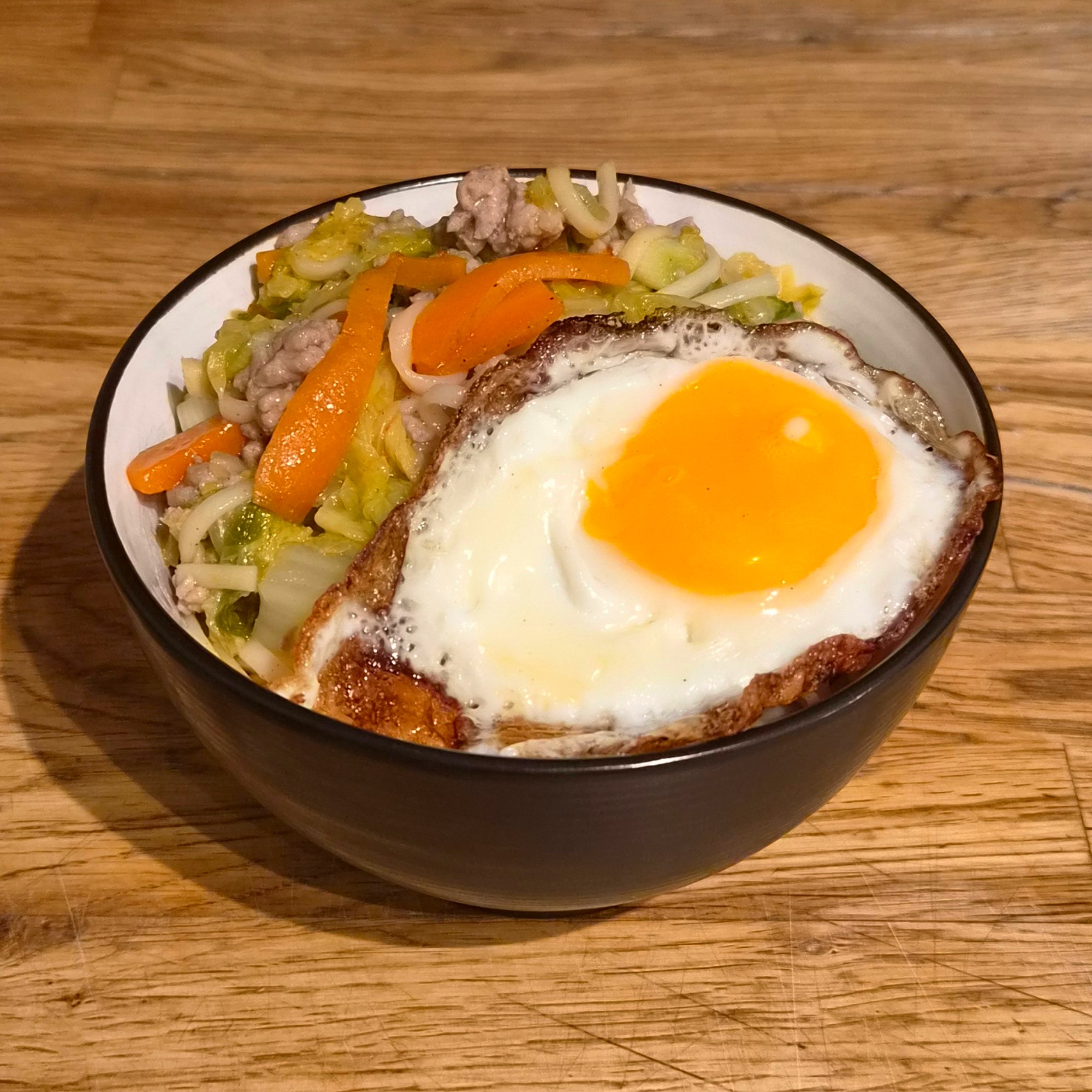
It was ok, but I misinterpreted the noodles and used dry ones instead of frozen or precooked ones, so the amount was probably 2.5 times too much. Apart from that, is there anything about the sauce or other parts that are still a ways away from proper Yaki Udon?
Hot hot hot fry pan, large with lots of space. Dont over crowd the pan. When the vegetables start leaking water, you dont want the liquid to just boil and stew your ingredients.
Traditional yaki soba or yaki udon is prepared on a large flattop for cooking to let the ingredients cook without stewing. Noodles are fried separately to the vegetables.
Sauce last. You want char marks on the ingredients. A little during cooking is fine in small doses if you have a large enough pan.
Udon can get soggy quickly, but you can prepare it a bit ahead of time. Par-boil it (frozen, fresh or dry), cool down in cold water and dry by shaking it off in a salad rinsing bowl or sieve. Leave aside, tossed in a little oil to keep them separated.
That said, dry udon is thinner than fresh or frozen udon.
I hope these help.
Thank you, that’s very helpful! I think part of the solution is to make smaller portions, or to do it in batches. 300 grams of cabbage just immediately fills the pan
Totally. But it does shrink over time!
Maybe look into a party-sized griddle. They usually sit in the middle of a table, for family grilling things.
They’re popular where I live for melting Raclette and grilling marinated meats and vegetables.
But, I use it as a flat top for pancakes, smash burgers, okonomiyaki, and yaki soba.
Look up “Hamilton beach griddle” and see what I mean, as an example. :)
Low sides to evaporate the moisture, large surface for nice charing.
I think Doubanjiang is more of a Chinese ingredient used in spicy dishes like mapo tofu. I’m sure it’s yummy in noodles but not traditional for a Japanese yaki udon. I think a sauce made with dashi (i.e. kelp, bonito or anchovy based), mirin, and soy sauce would be more traditional.
For yakisoba I recently used a Kenji LopezAlt recipe that was a good approximation of the popular yakisoba sauce sold at Japanese markets. It used ketchup, worstershire and oyster sauce, so IDK if it would be considered traditional but it did capture a flavor profile that I think is really popular in Japan